
A young man came in a while back with a camera bag he had picked up at a garage sale. He paid fifteen dollars for it, mostly because it was a nice bag.
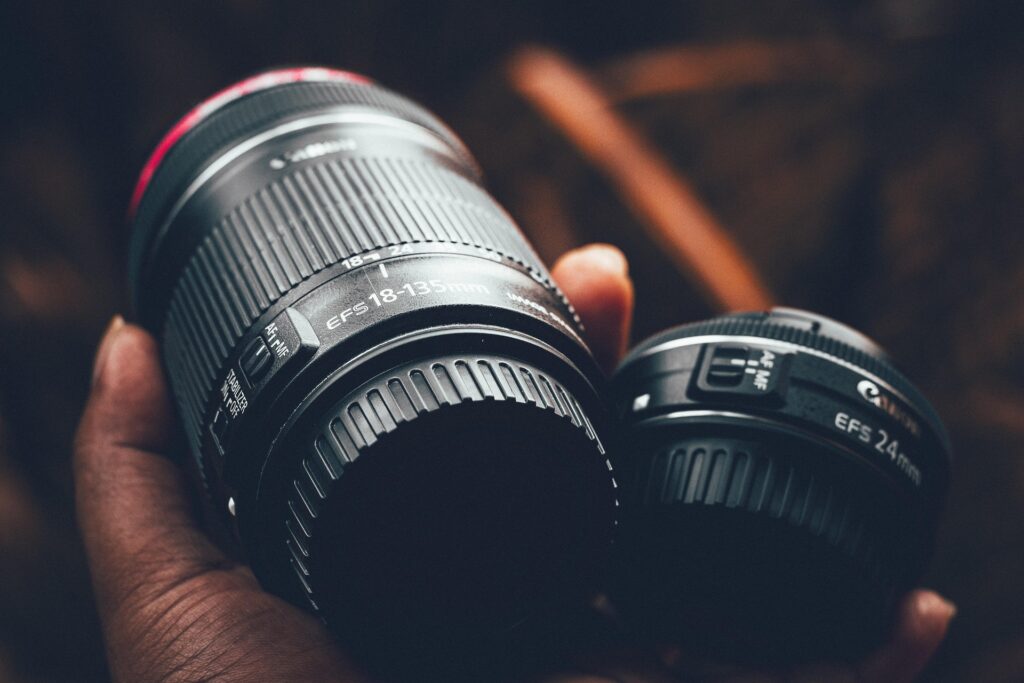
There was a Panasonic lens inside.
We paid him eight hundred dollars for it.
That is not a typical afternoon at the counter, and we are not going to pretend it is. But it happens often enough — usually with gear that has been sitting in a closet since someone switched systems, or that got inherited and nobody knew what it was — that it is worth saying out loud: most people have no idea what their old camera gear is actually worth. Some of them are sitting on more than they think. Most of them are sitting on less. Almost nobody knows which.
So here is exactly what happens when you walk in with something to sell, how we land on a number, and what we wish people knew before they got here.
At the counter: about five minutes
No appointment. Bring the gear to either store during business hours and ask for a buyer.
A buyer will take the item, inspect it, and test it. They are checking mechanical and electrical function, looking the body and glass over for condition, and noting what accessories came with it. Figure three to five minutes per item. Bring in a body and three lenses and you are looking at maybe twenty minutes, most of which you will spend leaning on the counter watching somebody who does this all day work through it quickly.
Two practical things to know before you come.
We only do this in person. We do not quote over the phone or by email, and it is not because we are being difficult. Every number in this business comes from actually handling the item — working the rings, checking the contacts, looking through the glass at an angle. A description over the phone is a guess, and a guess helps nobody. If we quoted you $600 sight-unseen and then had to walk it back to $350 when you drove out here, that would be a worse experience than just not quoting at all.
Bring your ID. You need to be at least 18 and have identification with you. That is standard for secondhand purchases and it protects everybody, including the person whose stolen gear does not end up in our case.
There is no charge for an evaluation and no obligation. Plenty of people bring gear in purely to find out what it is worth, hear the number, and decide to keep it. That is a perfectly good outcome and we are not bothered by it. We would much rather you know.
And the offer holds for a week. You do not have to decide at the counter. Take the number home, think about it, look around, come back Saturday. Seven days.
How we get to a number
This part is less mysterious than people expect.
We work out what we can realistically sell the item for, and then we offer you a number below that — enough below to make the transaction work for us, but fair, and in line with what you would be offered anywhere else doing this seriously.
That is it. There is no formula we are hiding. The gap between what we pay you and what we sell it for is what pays for testing it, cleaning it, guaranteeing it, putting it in a case where thousands of people will see it, and taking on the risk that it sits there for eight months or comes back with a problem.
What moves that number most is condition — which is worth its own section, because condition is where nearly every disagreement at this counter starts.
How we grade condition
We use a written scale. It is the same one we grade our own inventory against, so the standard we buy at is the standard we sell at.
| Grade | What it means |
|---|---|
| Like New | The item is in mint condition, with only slight signs of wear. |
| Excellent | The item has light wear or scuffs, but is otherwise in pristine condition. |
| Good | The item has been clearly used, showing marks and scratches. |
| Well Used | The item has been used, with significant visible signs of wear and tear. |
| Heavily Used | As the name suggests, this item may have dents and significant marks, but it still functions properly. |
| As-Is | Useable for parts only. Equipment may or may not work. No warranty or return privileges. |
Read those descriptions closely, because the words are doing real work. “Good” is not a compliment — it means clearly used, showing marks and scratches. Most gear that has been carried and enjoyed for a few years lands at Good or Well Used, and that is completely normal. It is not an insult. It is just what a camera looks like after it has been to Big Bend twice and a few hundred soccer games.
The two things people get wrong
Condition. Almost everyone thinks their gear is a grade or two higher than it is. This is not dishonesty — it is that you have looked at that camera a thousand times and stopped seeing it. The scuff on the baseplate, the dust in the zoom barrel, the tiny separation at the edge of the grip rubber: you stopped noticing those years ago. A buyer who handles a hundred of these a month notices all of them in about four seconds.
Here is a genuinely useful exercise before you come in. Take the scale above and grade your own gear honestly, as if it belonged to somebody else. Carry the lens to a window in daylight, hold it at an angle, and actually look at the front and rear elements and down the barrel. Work every ring and every button. Then look at the corners and edges of the body, where wear always shows first.
If you walk in having already decided “this is an Excellent, maybe a Good,” the conversation at the counter is going to go well. The people who have a hard time are the ones who arrive certain they have a Like New.
Open-market pricing. The other one is expecting us to pay what the item sells for between two private individuals. We cannot, and neither can anyone else who buys gear as a business — which brings us to the honest part.
No, we can’t match what you’d get selling it yourself
This is the objection we hear most, and it deserves a straight answer instead of a sales pitch.
You are right. If you list your gear yourself and find the right buyer and everything goes smoothly, you will usually net more than we will offer you. That is true and we are not going to argue with it.
What we would ask is that you run the actual math, not the sticker price. Say we offer you $700 by check, or $770 in trade credit, on a lens you think you could get $950 for online.
| Your listing price | $950.00 |
| eBay final value fee (13.6%) | −$129.20 |
| Per-order fee | −$0.40 |
| Shipping and insurance | −$25.00 |
| What actually lands in your account | $795.40 |
Against $770 in trade credit, you netted an extra twenty-five dollars. For that twenty-five dollars you wrote the listing, photographed the lens, answered questions from people who were never going to buy, boxed and insured it, drove to the post office, and then waited out the return window hoping the buyer was honest. If your buyer files a claim saying the lens arrived with fungus, you are the one arguing about it.
Against the $700 check the gap is bigger — about ninety-five dollars — and for some people that is worth the trouble. Genuinely. If you enjoy selling online and you are good at it, do that.
But the comparison people make in their head is “$950 versus $700,” and that is not the comparison. The real one is closer to “$795 in three weeks and some risk” versus “$770 in credit you can spend before you walk out the door, or a check written on the spot.”
The number worth knowing: trade credit beats a check by about 10%
Here is the practical thing most people do not know walking in.
If you take store credit instead of a check, you get roughly 10% more.
That is a real difference and it is worth a moment’s thought before you answer. If you are selling a lens because you are buying a different lens, taking the credit is simply the better deal — you were going to spend the money here anyway, and the 10% is free. If you need the money as money, take the check — and the check is written immediately, not mailed to you in three weeks. We will not make it awkward. But nobody should accidentally leave that on the table because they did not know to ask.
And then there is the manufacturer money
This is the part almost nobody knows about, and it is worth more than everything else on this page combined.
Canon, Sony, Nikon, and Panasonic all run their own trade-in bonus programs through authorized dealers. When one is active, the manufacturer adds money on top of whatever we offer you — you get our number for your old gear, plus a bonus from the brand, applied to the new body or lens you are buying. Depending on brand and model, that bonus currently runs anywhere from $100 to $800.
Two things to understand about them.
They are trade-up programs. The bonus is credit toward a new eligible product, bought at the same time. It is not cash and it does not apply if you are only selling. If you were already planning to upgrade, this is found money. If you just want your closet cleared out, it does not apply to you.
They run almost continuously. These are not rare events you have to wait for. Canon’s consumer trade-in windows have run back-to-back all year — June into July, July into August, August into September, September into October — with the eligible product list changing each month. Sony and Panasonic run on their own overlapping cycles.
Running right now (as of September 15, 2026): Canon — September 7 through October 4 · Sony — through September 30 · Panasonic — through September 26 · Nikon — through October 4, Z 5II only
Eligible products and bonus amounts change every cycle. Call or come in and ask what is active on the gear you are looking at.
The practical advice is simple: if you are trading in toward something new, ask us what manufacturer promotions are running before you decide anything. The answer changes monthly, it is not always advertised, and on the right combination it is worth several hundred dollars that you would otherwise never know existed.
The item does not go straight into the case.
After we buy it
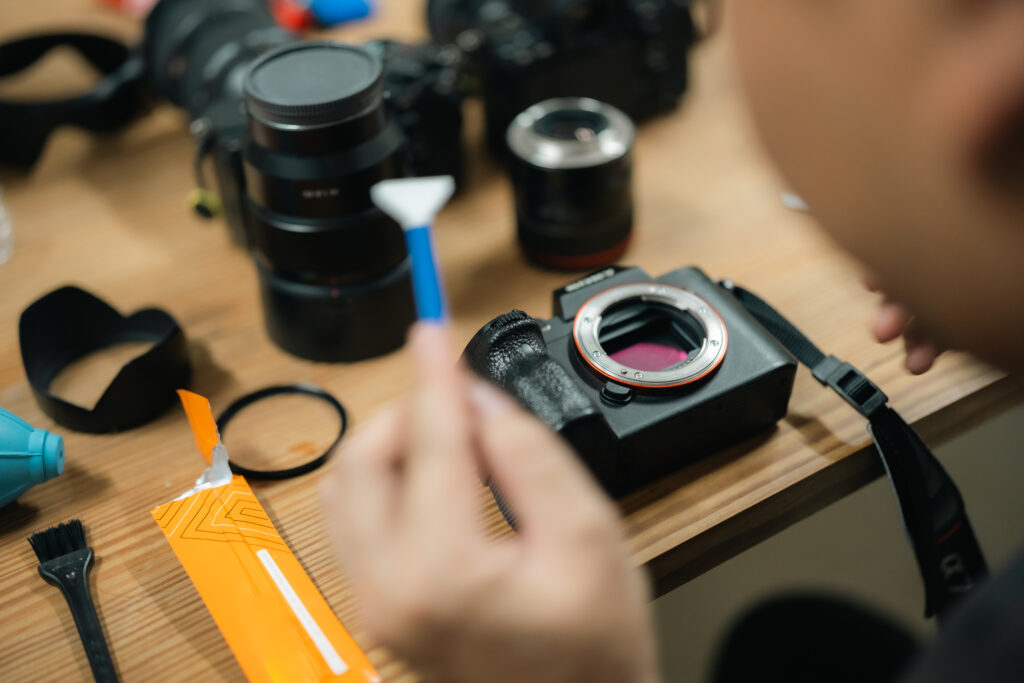
Once it is ours, it gets cleaned and tested again — a second pass, separate from the check at the counter. Only then does it get graded, priced, and put out.
And this is the part that matters most if you are ever on the buying side of that case: most used items we sell carry a one or two year warranty, and it is our warranty. Not a third party’s, not an extended service contract you file a claim against with a company in another state. Ours. If something goes wrong, you bring it back to the counter you bought it at and talk to us.
That is the whole answer to “why buy used here instead of from a stranger on the internet.” A private seller gives you a box and a handshake. If the shutter dies in month four, that is entirely your problem.
How to get the most for your gear
Nothing complicated. It is mostly about not leaving value in a drawer at home.
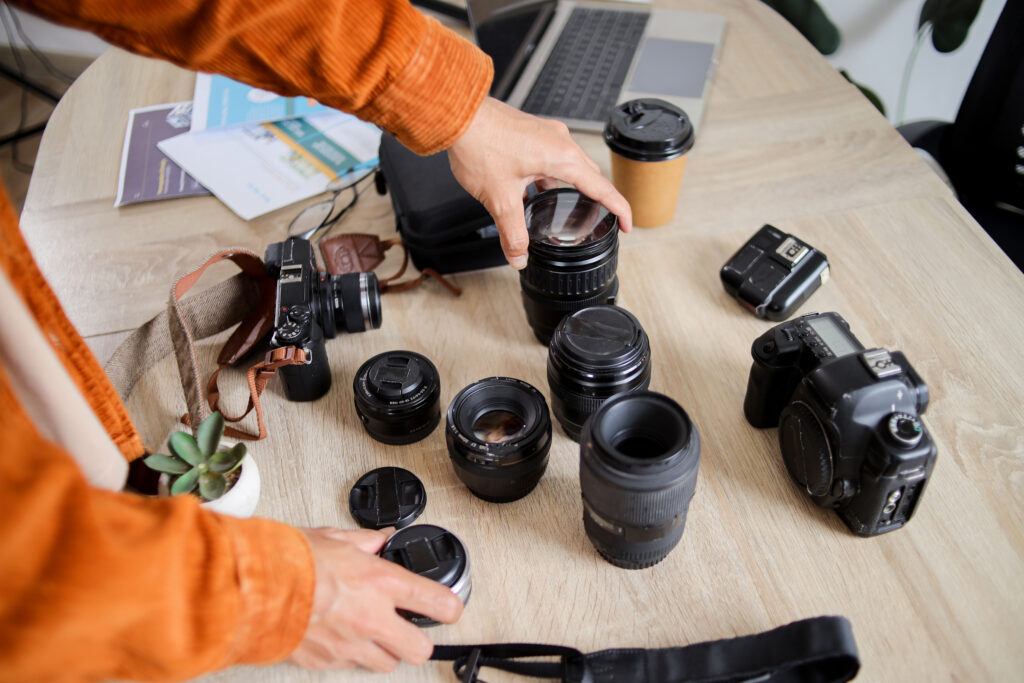
Bring the accessories. Batteries, chargers, body caps, rear lens caps, front caps, lens hoods, straps, original boxes, manuals, cables. All of it. Every missing piece is something we have to source before the item can go out, and that comes out of what we can offer you. A charger you left on the kitchen counter is real money.
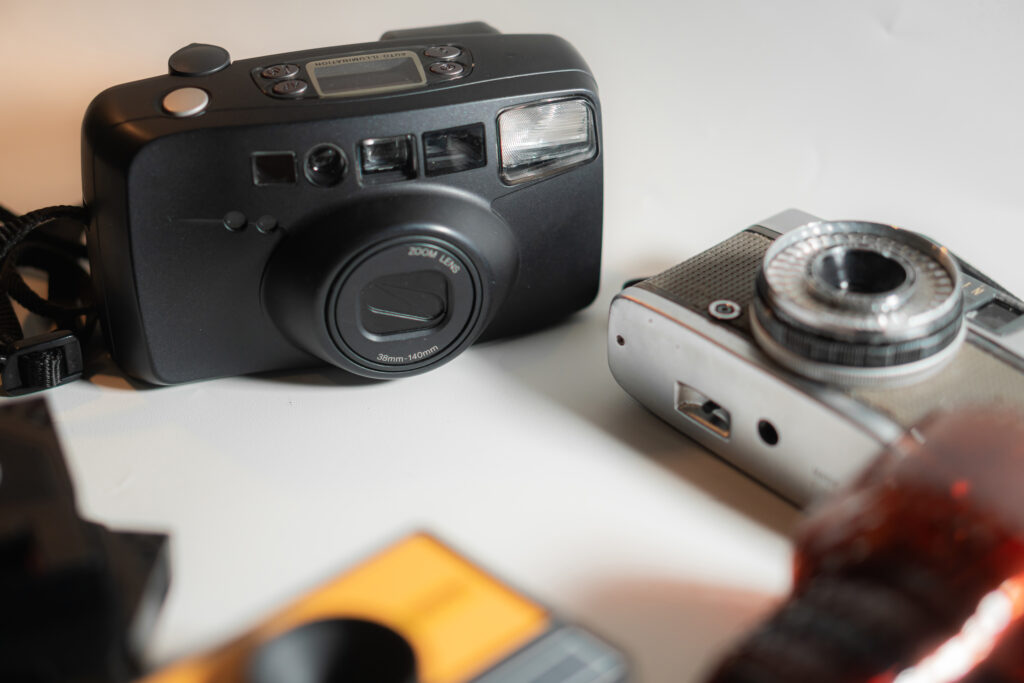
Bring everything, even the stuff you assume is worthless. We take everything for the right price. Old film bodies, off-brand flashes, a bag of filters, the tripod with the sticky leg, the lens for a mount nobody has used in fifteen years. Some of it is worth less than you hope. Some of it is the Panasonic in the garage sale bag. You will not know until someone looks, and looking is free.
Do not try to fix it first. If something is broken, bring it broken. Well-meant repairs usually cost more value than they recover.
Bring it by
Either store, no appointment. Ask for a buyer. Bring your ID. Five minutes per item and you will walk out knowing what you have — and the offer is good for a week, so you do not have to decide on the spot.
San Antonio: 6635 San Pedro Ave · 210-349-4400 Austin: 5907 Burnet Rd · 512-520-5161 Hours: Monday–Friday 10–7 · Saturday–Sunday 10–6
More on selling and trading: camerax.com/sell-your-used-photography-gear
And if you are on the other side of this and want to see what comes back out of that process: our used inventory.
Fifty-three years of looking across this counter at things people thought were worthless, and things people thought were priceless. We are usually happy to tell you which is which.