
Here is what happens to most people who bring a camera to Muertos Fest.
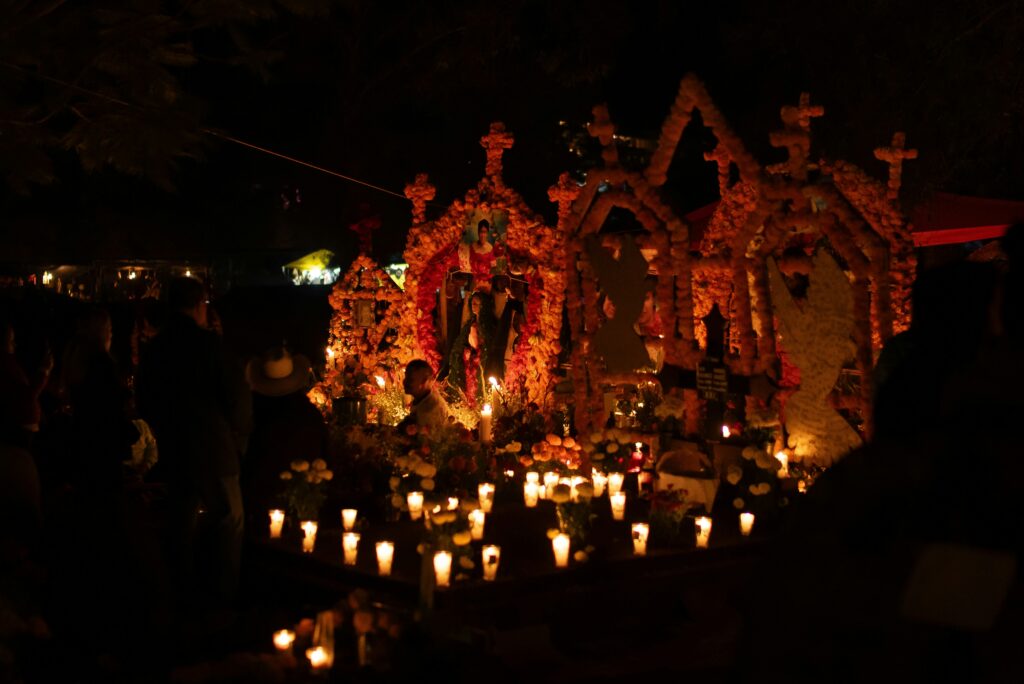
They arrive after dark, because after dark is when it is beautiful. They find an altar lit by a hundred candles, raise the camera, and get a photograph that is one-third motion blur, one-third orange smear, and one-third the back of a stranger’s head. Then they switch to the phone, which at least produces something, and the camera stays in the bag for the rest of the night.
None of that is a skill problem. Festival lighting after sunset is genuinely one of the hardest things you can ask a camera to do, and the default settings are actively working against you. But it is a solvable problem, and most of the solution is free.
Here is when everything happens this year, the settings that work, and one thing almost nobody thinks of that will get you better photographs of the altars than the festival itself will.
The part almost nobody knows about: the Tradition Trail
Start here, because it changes the whole plan.
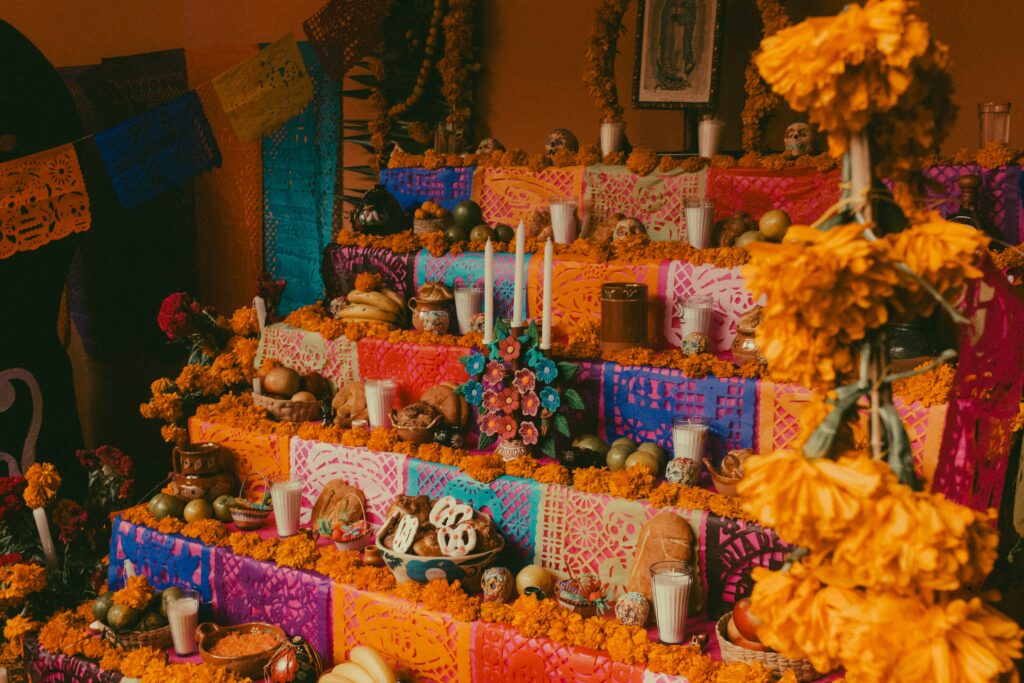
The San Antonio River Walk runs a Tradition Trail from October 2 through November 2 — ten alebrijes, ten large calaveras, and ofrendas installed at twenty-three locations along the river. It is free, it is self-paced, and it is up for a full month.
Think about what that means photographically. At Muertos Fest you are working in the dark, in a crowd of a hundred thousand people, with maybe forty seconds in front of each altar before you are in someone’s way. On the Tradition Trail you can go on a Tuesday morning. You can go at golden hour. You can come back three times. You can set up a shot, wait for the light, and take it properly.
If what you actually want is good photographs of the artwork and the ofrendas, the trail is the answer and the festival is not. Go to the festival for the crowd, the processions, the music and the faces. Go to the trail for the pictures you want to print.
While you are down there: La Villita has a 38.5-foot Catrina sculpture, described as the second-largest Calavera Catrina in the world. That one is worth a tripod and a wide lens on a quiet morning.
Everything else, with dates
| Event | When | Where | Cost |
|---|---|---|---|
| River Walk Tradition Trail | Oct 2 – Nov 2 | 23 locations along the River Walk | Free |
| Day of the Dead River Parade | Fri Oct 23, 7:00 p.m. | Starts near Lexington Ave; floats reach main viewing areas ~8:15–8:20 p.m. | Reserved seating ticketed; free standing-room from East Commerce St. |
| Muertos Fest (14th annual) | Fri Oct 23, 5–11 p.m. · Sat Oct 24, 10 a.m.–11 p.m. · Sun Oct 25, 12–9 p.m. | Hemisfair, 630 Nueva St. | Free |
| — Processions | Sat 7 p.m. · Sun 3 p.m. | ||
| Calaverita Run 5K & Family Walk | Sat Oct 24, evening | San Antonio | Ticketed |
| Viva la Vida Fest (43rd annual) | Sat Oct 24, 12–6 p.m. Grand Procession at noon | Austin — down 6th St, ending at E. 4th & Congress | Free |
| Día de los Muertos at the ESB-MACC | Sun Nov 1, 1–6 p.m. | 600 River St., Austin | Free |
Two scheduling collisions worth knowing before you plan:
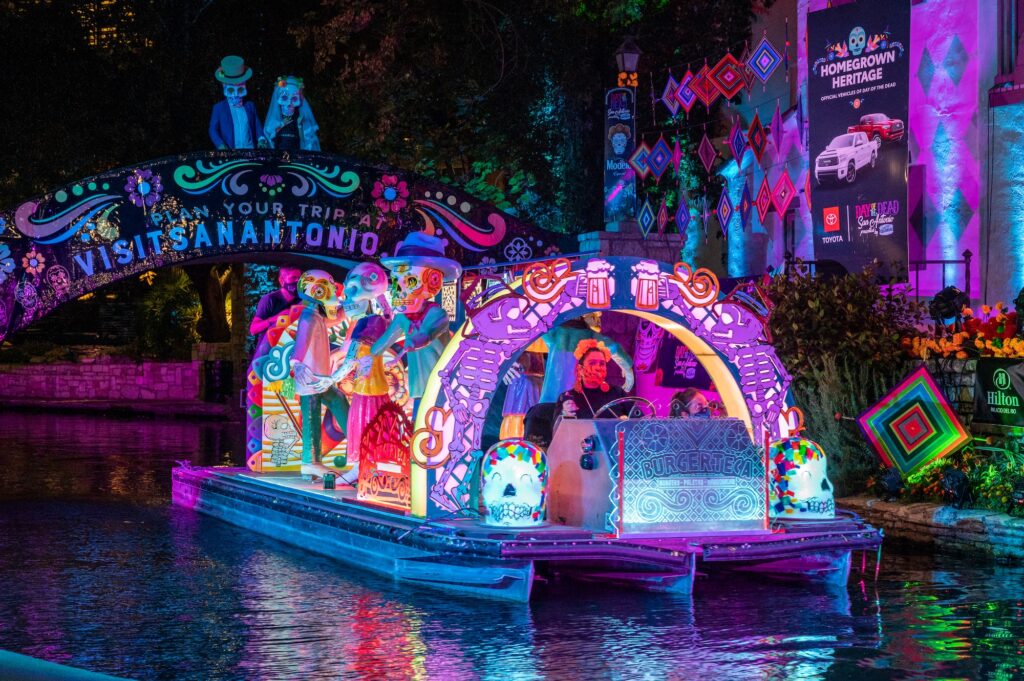
The River Parade and Muertos Fest both run Friday evening, October 23, and the parade steps off at 7 p.m. You can do both, but you will be moving.
And Muertos Fest Saturday is the same day as Austin’s Viva la Vida. You cannot do both cities on October 24 — pick one.
If it helps decide: Viva la Vida runs noon to six, in daylight. It is the easiest of these to photograph well, and this year’s theme is la ofrenda. If you are nervous about shooting in the dark, start there.
Mexic-Arte Museum also has Día de los Muertos: Coleccionando Memorias up from September 11 through January 3 — $8 for adults, and free for everyone on Sundays.
Why your kit lens cannot do this
Here is the honest arithmetic. These are the ISOs you need to hold a usable shutter speed at a festival after dark.
At 1/250 — fast enough for a procession or dancers:
| f/1.8 prime | f/2.8 zoom | f/5.6 kit zoom | |
|---|---|---|---|
| Bright stage or string lights | ISO 1,250 | ISO 3,000 | ISO 12,000 |
| Typical festival midway at night | ISO 2,500 | ISO 6,000 | ISO 24,500 |
| Dim altar area | ISO 5,000 | ISO 12,250 | ISO 49,000 |
Look across the bottom row. That kit zoom — the 55-250mm or 18-140mm most people own — is asking for ISO 24,000 just to photograph the procession. No consumer sensor makes a usable file there. It is not that you are doing it wrong; you are two and a half stops short of the light you need.
The same scene on a 50mm f/1.8 wants ISO 2,500, which any camera made in the last decade handles comfortably.
That one lens is the cheapest meaningful upgrade in photography, and this is exactly the night it was made for. If you do not own one and do not want to buy one on spec, rent one for the weekend. We rent from both stores, and a fast prime for a Saturday costs a fraction of owning it.
The settings that actually work
Auto ISO with a minimum shutter speed. This is the single most important setting on this page, and most people have never turned it on.
Put the camera in aperture priority, open the lens all the way, then go into the Auto ISO menu and set a minimum shutter speed — 1/125 if people are standing still, 1/250 for processions and dancers. Set the ISO ceiling high and mean it; 12800 is fine. Now the camera holds your shutter speed and raises ISO to pay for it, which is exactly the trade you want. You stop thinking about exposure and start thinking about where to stand.
A sharp noisy frame beats a clean blurry one. Always. Noise reduction has gotten remarkably good and motion blur is permanent. Stop being precious about ISO.
Lock your white balance. Candlelight and marigolds are the warmest thing you will photograph all year, and that warmth is the entire look. Auto white balance is designed to remove exactly that. Set it to Daylight or around 4000K and leave it — same rule as shooting golden hour, same reason.
Shoot RAW. You will be lifting shadows and adjusting color, and RAW gives you room that JPEG does not.
Help the autofocus. AF systems hunt in the dark because they need edges and contrast. Give them one: a single focus point placed on a candle flame’s edge, the rim of a lit face, the white of an eye. Face and eye detection works surprisingly well on Catrina makeup — the high contrast helps it. If the camera keeps racking back and forth, switch to a single point and put it on something bright.
Turn the flash off and leave it off. It will not reach the procession, it flattens everything it does reach, it ruins the ambient light you came for, and pointing it at someone’s memorial altar is a bad thing to do. There is no situation here where it helps.
About photographing the altars and the people
A note, in our own voice — none of the festivals publish etiquette rules, so this is our advice rather than anybody’s policy.
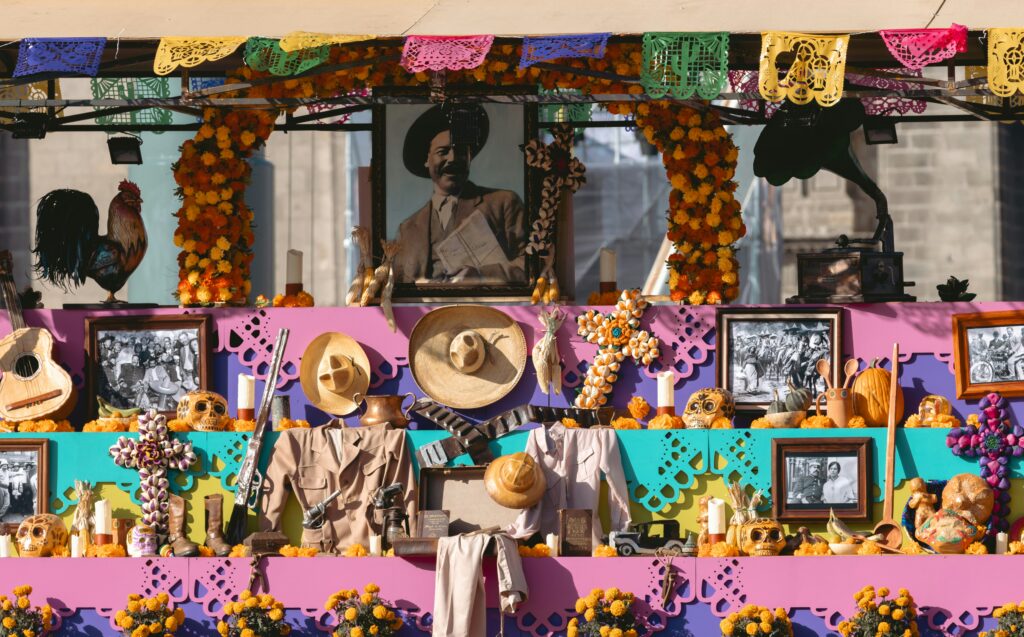
Muertos Fest has more than eighty handmade altars. Those are not decorations. Each one was built by a particular family or group as a memorial to a particular person who died, often this year, and the people standing beside them are frequently that person’s family.
That does not mean do not photograph them. These events are public, joyful, and genuinely welcoming to photographers — the Saturday procession is broadcast live on television. It means use some judgment about which is which.
Our rules of thumb:
- The artwork is fair game. Alebrijes, calaveras, the big Catrina, the installations along the Tradition Trail — photograph away.
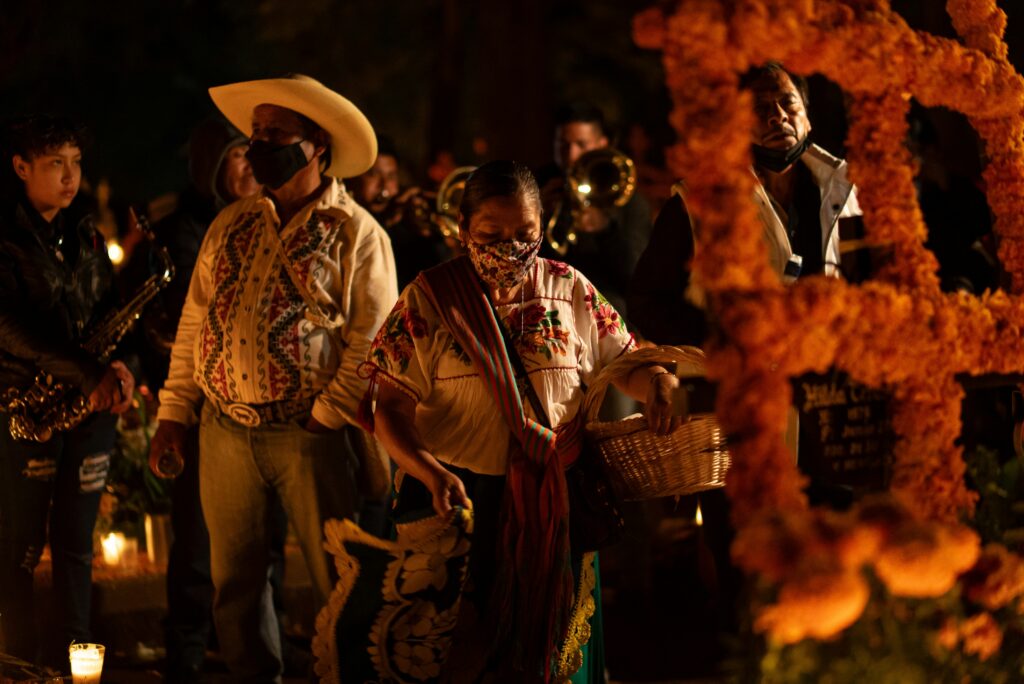
- People in costume and face paint usually want to be photographed. Someone who spent three hours on Catrina makeup is generally delighted. Make eye contact, lift the camera slightly, wait for the nod. It takes two seconds and the portrait is better for it.
- A family standing at their own ofrenda is a different situation. Ask. Most will say yes and often tell you about the person — which is the whole point of the tradition, and you will leave with a better photograph and a better evening.
- Do not touch or rearrange anything on an altar. Not the marigolds, not the photographs, not the candles. Shoot it as the family built it.
- No flash, as above. Both because it looks bad and because it is intrusive at a memorial.
- If someone says no, that is the end of it. Smile, say thank you, move on.
None of this is burdensome and all of it makes for better pictures. People who have agreed to be photographed give you something that people caught unaware never do.
What to actually shoot
Stop trying to photograph the whole festival. Photograph small things.
Hands. Lighting candles, arranging marigolds, holding a photograph. Hands tell the story without the complication of asking a face for permission.
Details on the altars. The grain of the papel picado, wax running down a candle, a name handwritten on a card, a plate of somebody’s favorite food. These are the frames that mean something later.
Marigold petals. Nothing else you photograph this year will be that color.
The procession from the side. Everyone shoots head-on. Step to the edge, shoot along the line, and let it compress.
Faces, with permission. The best photographs you make all weekend will be portraits of people who agreed to be in them.
Blue hour, right at the start. About twenty-five minutes after sunset, the sky still holds color and the candles and lights are already on. That window is the single best light of the night, and most people are still parking.
What to bring
- A fast prime — a 35mm or 50mm f/1.8 is the whole game here. If you own one, this is its night.
- Used lenses — fast primes hold up extremely well used, and it is the smart way into f/1.8 or f/1.4.
- Memory cards — you will shoot more frames than you expect.
- Spare batteries – High ISO, continuous AF and a cold night will drain one faster than you think.
- A small bag. The River Parade prohibits strollers and ice chests, and you will be in crowds all evening — carry less than you want to.
🎃 Rent the lens for the weekend
Both stores rent, and this is the ideal use for it: take out a fast prime for the Muertos Fest weekend, shoot one real night with it, and decide afterward with actual files in front of you.
San Antonio: 6635 San Pedro Ave · 210-349-4400 · cameraxrentals.com
Austin: 5907 Burnet Rd · 512-520-5161 · austin.cameraxrentals.com
And if Auto ISO and minimum shutter speed are new terms, that is precisely what our Photography 101 and 201 classes in San Antonio cover — hands-on, with your own camera, in small groups. (Sign Up Here)
Fifty-three years in San Antonio, and this is still our favorite weekend of the year to be out with a camera.