
If you have spent a Texas summer trying to make a photograph before 8 p.m., you already know the problem. The light is straight overhead, it is hard as a hammer, and everything more than a mile away disappears into a wall of haze. You wait for the sun to drop, and by the time it finally does, it is nearly bedtime.
Then the first real cold front comes through, and everything changes.
Fall is the best light Texas gets all year, and it is not close. The sun tracks lower and further south, so the warm window lasts longer. The air dries out, so the Hill Country actually looks like the Hill Country instead of a gray smudge. And best of all, golden hour moves to a time when a normal person with a job can actually get to it.
Whether you are shooting your first landscape, building a portrait portfolio, or just tired of your phone flattening every sunset you have ever seen, the next ten weeks are the ones to use. Here is when to go, where to go, and how to keep the warmth in your files once you get there.
Why Fall Light Hits Different Here
Three things happen to Texas light between September and Thanksgiving, and all three work in your favor.
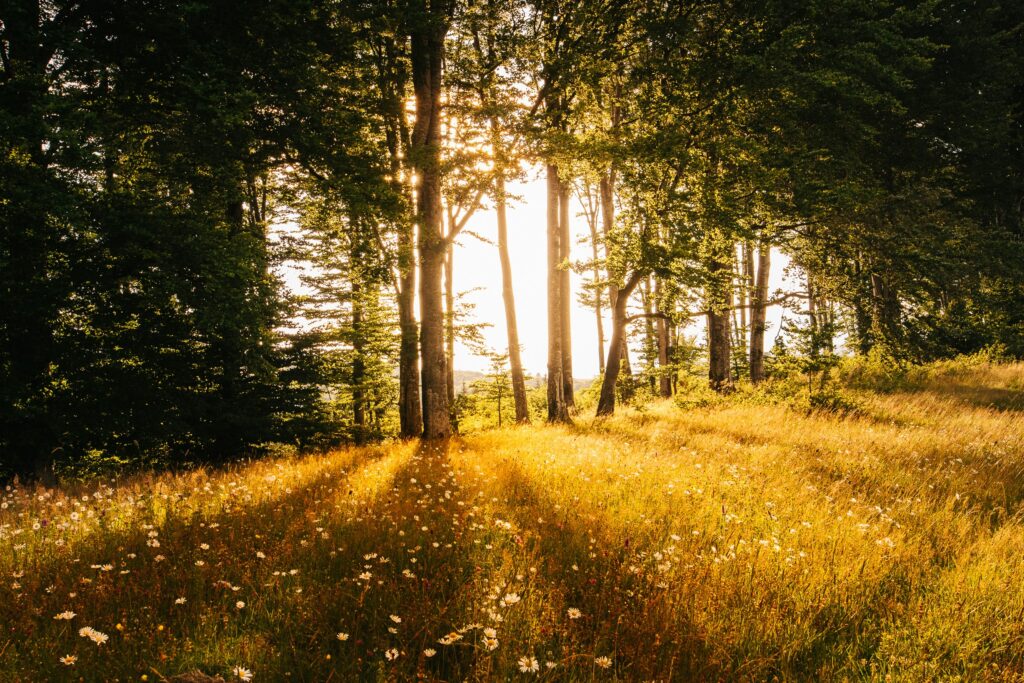
The sun gets lazier. As we move toward the solstice, the sun sets at a shallower angle. In June it drops toward the horizon almost straight down and golden hour is over before you have found your footing. In November it slides in sideways, which stretches the good light out and rakes it across the side of everything — limestone, live oak bark, a face, a building. Side light is what makes a photograph look three-dimensional.
The air clears out. Summer haze in Central Texas is a mix of humidity, dust, and whatever is blowing in off the Gulf. After a couple of fronts move through, distant ridgelines sharpen up and you can finally shoot a long lens across a valley without the file looking like it was taken through wax paper.
The color temperature drops further. Low-angle sun travels through more atmosphere, which strips out the blue and leaves the orange. That is the whole trick. It is also the thing most cameras will quietly undo for you — more on that below.
Mark Your Calendar: November 1st Changes Everything
This is the single most useful thing in this post, so do not skim it.
Daylight Saving Time ends on Sunday, November 1, 2026. Sunset in Austin goes from 6:43 p.m. on Saturday to 5:43 p.m. on Sunday. Overnight, golden hour stops being an “if I leave work early” proposition and becomes something you can do on a Tuesday.
Here is roughly how the warm window moves this fall:
| Date | Austin sunset | San Antonio sunset | Golden hour starts (approx.) |
|---|---|---|---|
| Sept 1 | 7:53 p.m. | 7:55 p.m. | ~7:22 p.m. |
| Sept 15 | 7:36 p.m. | 7:38 p.m. | ~7:05 p.m. |
| Oct 1 | 7:15 p.m. | 7:19 p.m. | ~6:45 p.m. |
| Oct 15 | 6:59 p.m. | 7:03 p.m. | ~6:28 p.m. |
| Oct 31 | 6:43 p.m. | 6:48 p.m. | ~6:11 p.m. |
| Nov 1 | 5:43 p.m. | 5:47 p.m. | ~5:10 p.m. |
| Nov 15 | 5:34 p.m. | 5:38 p.m. | ~5:00 p.m. |
| Nov 30 | 5:29 p.m. | 5:34 p.m. | ~4:55 p.m. |
Two notes on using this table. First, plan to be set up and composed a full thirty minutes before sunset — the best light usually arrives before you expect it, not after. Second, do not pack up when the sun disappears. Civil twilight runs roughly twenty-five minutes past sunset, and that blue-hour window is when city skylines, the River Walk, and anything with a light in a window look their absolute best.
Austin: Four Places Worth the Drive
Mount Bonnell (Covert Park). The classic for a reason — a 784-foot promontory with panoramic views over Lake Austin and the western hills, which is exactly the direction you want in the evening. Open 5 a.m. to 10 p.m., so you have room on both ends of the day. It is a short, steep climb and it gets crowded on clear evenings, so arrive early enough to claim a spot on the wall. A short telephoto compresses the river bends better than a wide angle here.
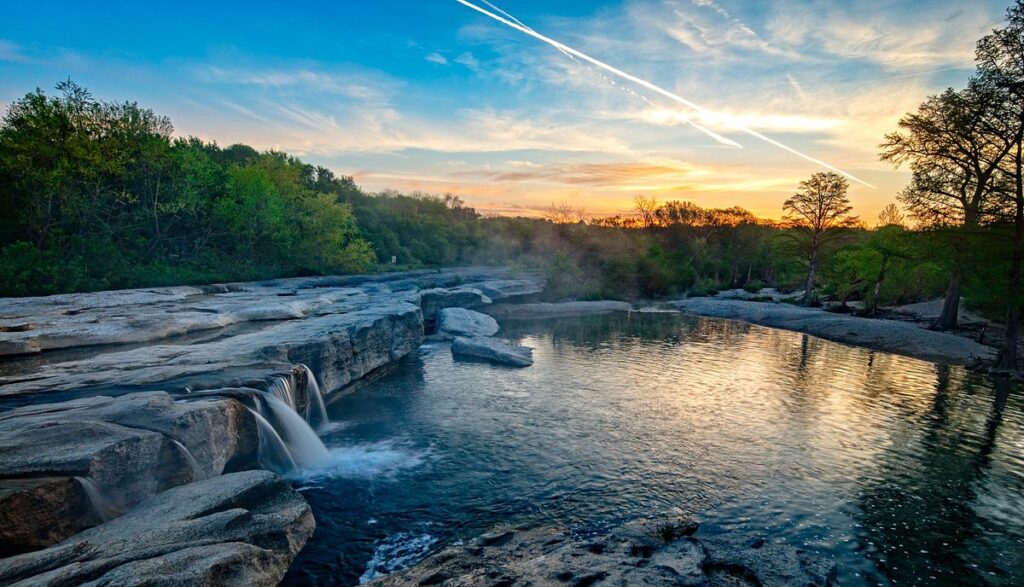
McKinney Falls State Park. Fifteen minutes from downtown and badly underused by photographers. The bald cypress along Onion Creek turn rusty orange in November, and the limestone ledges at the upper and lower falls take low side light beautifully. The gate is open 8 a.m. to 10 p.m., which makes this one of the few parks in the area where you can shoot both sunrise and sunset. Entry is $6 for adults and the park often reaches capacity — reserve a day pass before you drive out.
Auditorium Shores at Lady Bird Lake. You are facing the downtown skyline, which means the last light of the day is hitting the glass towers head-on while you shoot from the shade. Stay for blue hour; the reflection in the lake is the shot. One heads-up: several stretches of the Butler Trail on the north shore are under construction into 2027 and beyond, so check the city’s closures page if you were planning to loop the lake on foot.
The Congress Avenue Bridge bats. The colony emerges from the east side of the bridge, with most bats flying about five minutes after the sun goes down — though the full emergence can take up to 45 minutes. Go sooner rather than later: the Mexican free-tailed bats head for Mexico as temperatures drop through September and October, so September is a much safer bet than Halloween. This one is a genuine test of your camera’s high-ISO performance and your ability to pan.
San Antonio: Four Places Worth the Drive
The Missions. This is the best golden-hour subject in the city and it is not particularly close either. The grounds at San José, Concepción, San Juan, and Espada are open sunrise to sunset, and low-angle light on 300-year-old limestone is exactly the kind of texture side light was made for. The buildings themselves close at 5 p.m., so plan for exteriors. Mission San José’s facade and the Rose Window are the headline, but Concepción’s weathered walls may be the better photograph.
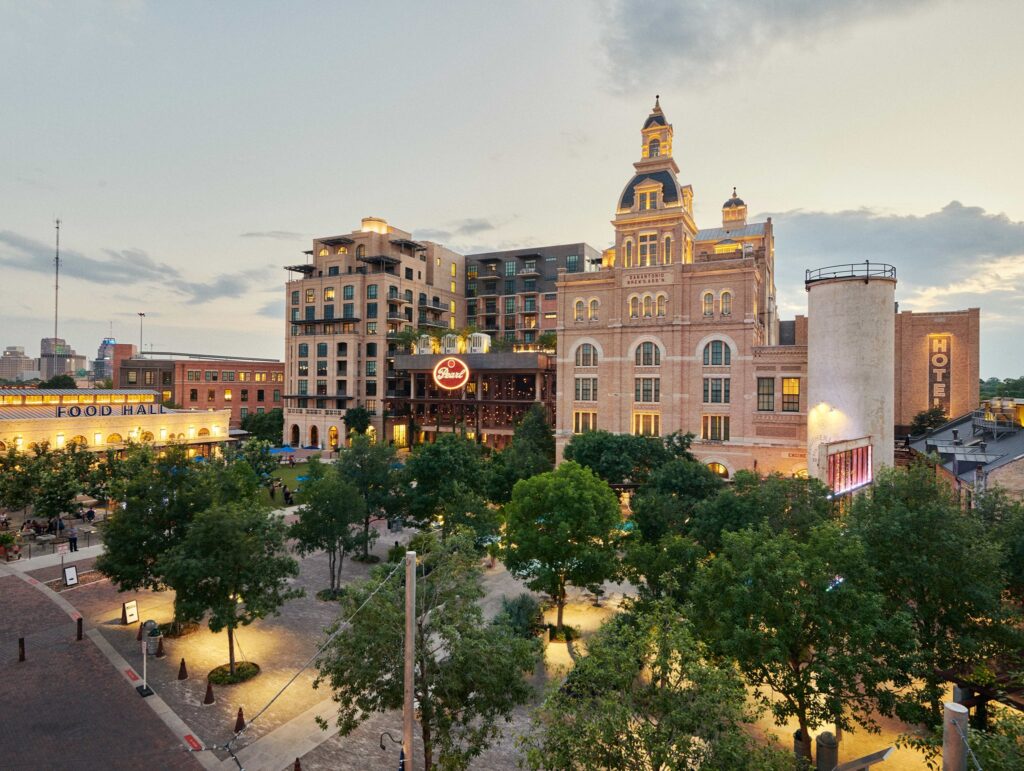
The Pearl and the Museum Reach. Warm light on the brewery brick, then blue hour on the river with the lights coming up. Fifteen minutes of walking gets you both.
Hemisfair and the Tower of the Americas. Good for the reverse shot — put the tower against a colored sky rather than trying to shoot from it.
The Japanese Tea Garden at Brackenridge Park — but go at sunrise. Sheltered, green, and full of stonework that takes side light beautifully. The catch is that the garden is open 7 a.m. to 5 p.m., which means it closes before the evening light ever arrives. Admission is free, so make this your morning shoot: get there at opening in October or November and you will have soft, low light and the place largely to yourself. Morning golden hour is the most underrated light in Texas, mostly because nobody wants to get up for it.
Two Hill Country Day Trips
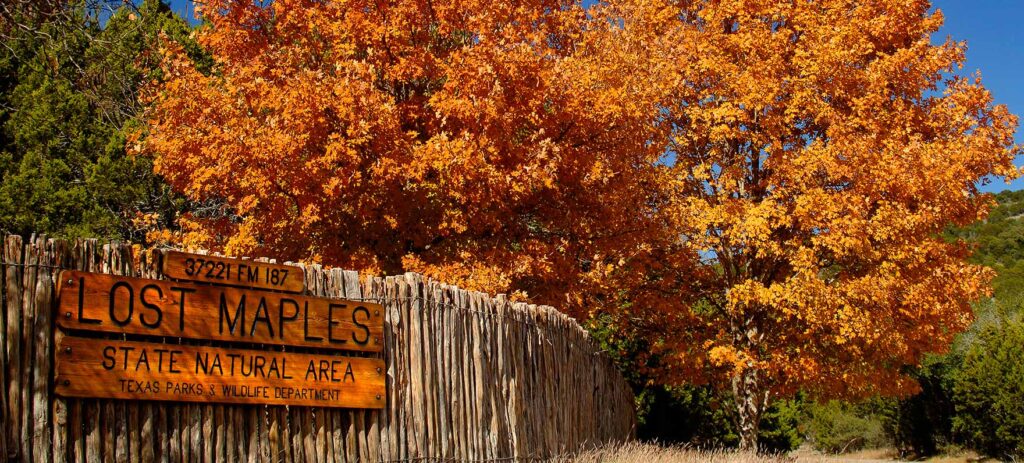
Lost Maples State Natural Area (Vanderpool). The bigtooth maples here are the closest thing Texas has to a New England fall. Now the part most guides leave out: TPWD posts the park’s hours as 8:30 a.m. to 4:30 p.m. You are not shooting golden hour at Lost Maples. Plan the trip as a midday trip and stop being annoyed about it — flat, overcast light is genuinely better for foliage than direct sun, because it saturates color without blowing out the bright leaves or crushing the shadows between them. A cloudy Tuesday in early November is the ideal Lost Maples day, not a bluebird sunset.
Two more things. Peak color swings by a couple of weeks depending on the weather, and TPWD publishes a fall foliage report starting in mid-October — check it before you commit to a two-hour drive. And reserve a day pass in advance: the park reaches capacity daily in October and November, and people get turned around at the gate every single weekend.
Enchanted Rock State Natural Area (Fredericksburg). Trails are open until half an hour after sunset, so a summit sunset is legitimately doable — but you are then descending a granite dome in fading light, so bring a headlamp and know the route. Day passes are $8 for adults and worth reserving; September through May is the busy season.
Keeping the Warmth: Settings That Matter
Turn off Auto White Balance. This is the mistake we see most often, and it is heartbreaking. Your camera’s AWB is designed to neutralize color casts — and golden hour is a color cast. You drive an hour, wait for perfect light, and the camera helpfully takes the gold back out. Set your white balance to Daylight or Cloudy and shoot the light you actually see.
Expose for the highlights. Fall skies at sunset have far more dynamic range than any sensor. Protect the bright sky, let the foreground go dark, and lift the shadows later. If you are shooting RAW you have far more room down than up.
Use a polarizer — carefully. A circular polarizer cuts glare off water and leaves and deepens a blue sky, which is a gift in October. But it costs you a stop or two of light, and rotated too far on a wide lens it will band your sky unevenly. Dial it back from maximum.
Bring a tripod for blue hour. Everything after sunset is a one-second exposure. This is not optional.
Shoot into the light on purpose. Backlit grass, backlit hair, backlit dust from a truck on a caliche road — put the sun just outside the frame and let it rim the edges. Use your lens hood, and clean your front element first, because fall light will find every smudge.
Gear worth checking before you go
- A tripod that will actually hold still. Recommended: ProMaster Epoch 328
- A circular polarizer in your filter size. Shop Circular Polarizers
- A short telephoto for compression. Shop 70-200mm Telephoto Lenses
- Used bodies and lenses. Fall is when the used case turns over fastest. Shop Used Gear
📸 Want to learn how to take great photos at golden hour?
Start with your camera settings.
That warm, low light everyone chases takes a bit of know-how to capture well, and that starts with understanding your camera. Our Photography 101 and 201 classes cover the fundamentals, exposure, aperture, shutter speed, ISO, hands-on, with your own gear, so you know exactly what your camera is doing and why.
San Antonio: View Upcoming Schedule · 6635 San Pedro Ave • 210-349-4400
Not sure your kit is up to it? Bring it by either store and we will take a look, clean your sensor, and tell you honestly whether you need anything at all. We have been doing this in Texas since 1973.